Region four
Lowlands
The region that makes most of the whisky in Scotland by volume and gets the least credit for it, on the grounds that the volume in question is grain spirit for blends.
The line, and what sits below it
The Lowland region is everything south of the historic Highland line, the excise boundary that runs roughly from the Clyde near Greenock to the Tay near Dundee. It takes in Ayrshire, the central belt, the Borders, Fife and Dumfries and Galloway. Bladnoch, in Wigtownshire, is the southernmost working malt distillery in Scotland.
The region's shape was set by industry rather than tradition. Ports, coal, grain-growing land and the two biggest cities meant large-scale distilling was viable here long before it was elsewhere, and it meant the Lowlands became the home of the blending trade.
Grain whisky: the category that built Scotch
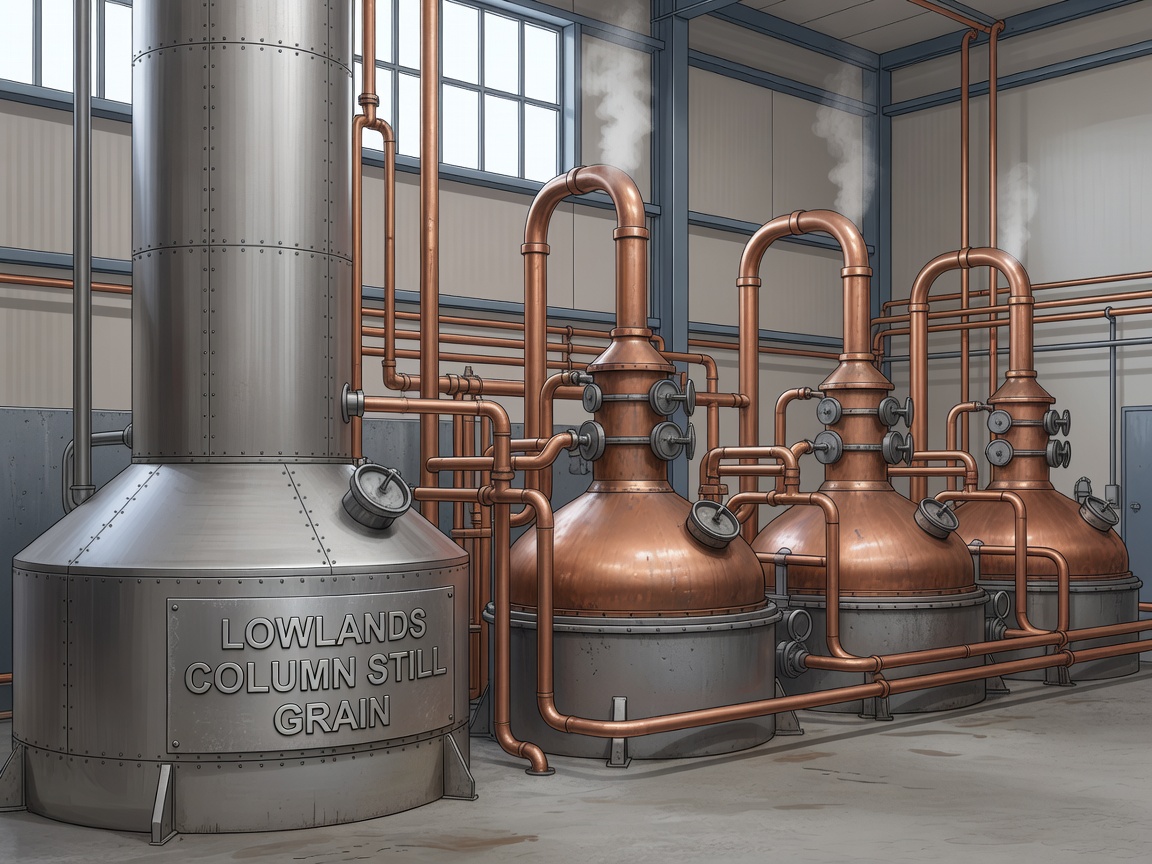
Blended Scotch whisky — the category that took Scotch to the rest of the world — is malt whisky married with grain whisky. Grain whisky is made from cereals other than malted barley, typically wheat or maize with a small proportion of malted barley for enzymes, and it is distilled in a continuous column still rather than a pot still. The column still, developed in the nineteenth century and associated above all with Aeneas Coffey's patent, runs without stopping and produces spirit at a higher strength and lighter character than any pot still can manage.
The Lowland grain distilleries are industrial sites: Cameronbridge in Fife, North British in Edinburgh, Strathclyde in Glasgow and Girvan in Ayrshire among them. Their output rarely appears under its own name, which is why "single grain Scotch whisky" on a label still surprises people. It is a legitimate category defined in the Scotch Whisky Regulations 2009, and it means one distillery's grain whisky, unmixed with any other.
Triple distillation and the Lowland malt style
The Lowland malt reputation — lighter, drier, grassier — comes largely from a distillation regime rather than from soil or water. Auchentoshan, on the northern edge of Glasgow, distils three times rather than twice. Each additional distillation raises the strength of the spirit coming off and narrows what survives: more copper contact, fewer heavy compounds, a cleaner and more delicate new make. Rosebank distilled three times historically and its restoration follows that tradition.
The trade-off is real. A lighter spirit reveals cask influence quickly, which can be an advantage in active wood and a liability in tired wood. It also gives a bottler fewer places to hide: there is less weight in the glass to cover an indifferent cask. Glenkinchie, in East Lothian, takes the alternative route to lightness — double distillation in large stills with a worm tub — and produces a recognisably Lowland style by different means.
The revival, and what it changed
For much of the twentieth century the Lowland malt category came close to disappearing as blending consolidated and distilleries closed. The reopening of the region has come from three directions at once.
- Farm distilleries. Daftmill in Fife operates on a working farm and releases small quantities from its own barley. Kingsbarns, also in Fife, took a similar single-site approach.
- Heritage sites. Lindores Abbey Distillery stands at the Fife site named in the Exchequer Rolls entry of 1494 recording malt supplied to Friar John Cor for making aqua vitae — the earliest documentary reference usually cited in Scotch whisky history.
- City distilleries. Clydeside in Glasgow and Holyrood in Edinburgh brought distilling back inside the cities that had built the blending houses, generally with a visitor operation attached.
Alongside them, Ailsa Bay at Girvan produces malt spirit on the same site as a major grain distillery, and Bladnoch continues in the far south-west. The result is a region with more malt distilleries than it has had in a long time, most of them too young for the long age statements that dominate the conversation elsewhere.
Cask policy for a lighter spirit
Lowland malt makers tend to lean on ex-bourbon American oak, first-fill and refill, where vanilla and orchard fruit complement a delicate distillate. Sherry-seasoned casks are used, but the risk of the wood outrunning the spirit is higher than it would be with a heavy worm-tub make. Several of the newer distilleries are open about experimenting with other cask types within the rules; the honest position on any of that is that the results take years to evaluate, and anyone claiming a verdict early is guessing.
Reading a Lowland label
Two words are worth pausing on. "Single grain" means one distillery, not one cask and not one grain. "Triple distilled" is a genuine production statement and a reliable signal of a lighter style, but it is not a quality claim — plenty of excellent Scotch is distilled twice and a little is distilled two and a half times. Where a young Lowland malt carries no age statement, the label may still state the cask type and strength, and those will tell you far more about what is in the bottle.
Worth a side-by-side
Grain against malt
A single grain bottling next to a Lowland single malt is the cheapest education in Scotch available. One is built for lightness by continuous distillation, the other by still shape and an extra pass. Hearing how differently they carry the same cask type explains more about blending than any diagram.