Region three
Highlands
The biggest region on the list, covering most of Scotland's land area and a good deal of its coastline and islands. Asking what Highland whisky tastes like is a little like asking what European food tastes like.
How the boundary was drawn
The Highland region is everything north of the old Highland line, an excise boundary running roughly from the Clyde in the west to the Tay in the east, minus the Speyside area carved out within it and minus the two island localities that have their own status. Scotland's other whisky islands — Orkney, Skye, Mull, Jura, Arran, Raasay — sit inside the Highland region for labelling purposes. "Island whisky" is a useful shorthand used by writers and retailers. It is not a category in the regulations.
Because the region was defined by exclusion rather than by any shared characteristic, it contains almost the full stylistic spread available in Scotland: coastal and inland, peated and unpeated, waxy, floral, oily, sherried and dry.
The clusters worth knowing
- Northern. The coastal run from Ross-shire to Caithness: Glenmorangie with its unusually tall stills, Dalmore with its sherry-forward house style, Balblair, Clynelish and Old Pulteney at Wick, with Wolfburn at Thurso at the top of the mainland.
- Western. Sparse and coastal — Oban at the head of its own harbour town, Ben Nevis at Fort William, and Ardnamurchan on the peninsula.
- Eastern. Glen Garioch, Fettercairn, Glencadam and the Angus and Aberdeenshire distilleries that historically supplied the blending trade.
- Central and southern. Aberfeldy, Edradour, Glenturret, Deanston, Tullibardine and Blair Athol, spread across Perthshire and the southern approaches.
- Islands. Highland Park and Scapa on Orkney, Talisker on Skye, Tobermory and its peated Ledaig on Mull, Jura, Arran and Raasay.
What actually sets the style
Since geography explains so little here, the equipment explains more. Four levers do most of the work.
Still shape and size. Glenmorangie's stills are among the tallest in Scotland, and height gives vapour more opportunity to condense and fall back, producing a lighter, more floral spirit. Short stills with wide necks give the opposite. This is a physical constraint, not a stylistic preference: change the still and you change the whisky, which is why replacement stills are usually copied dent for dent.
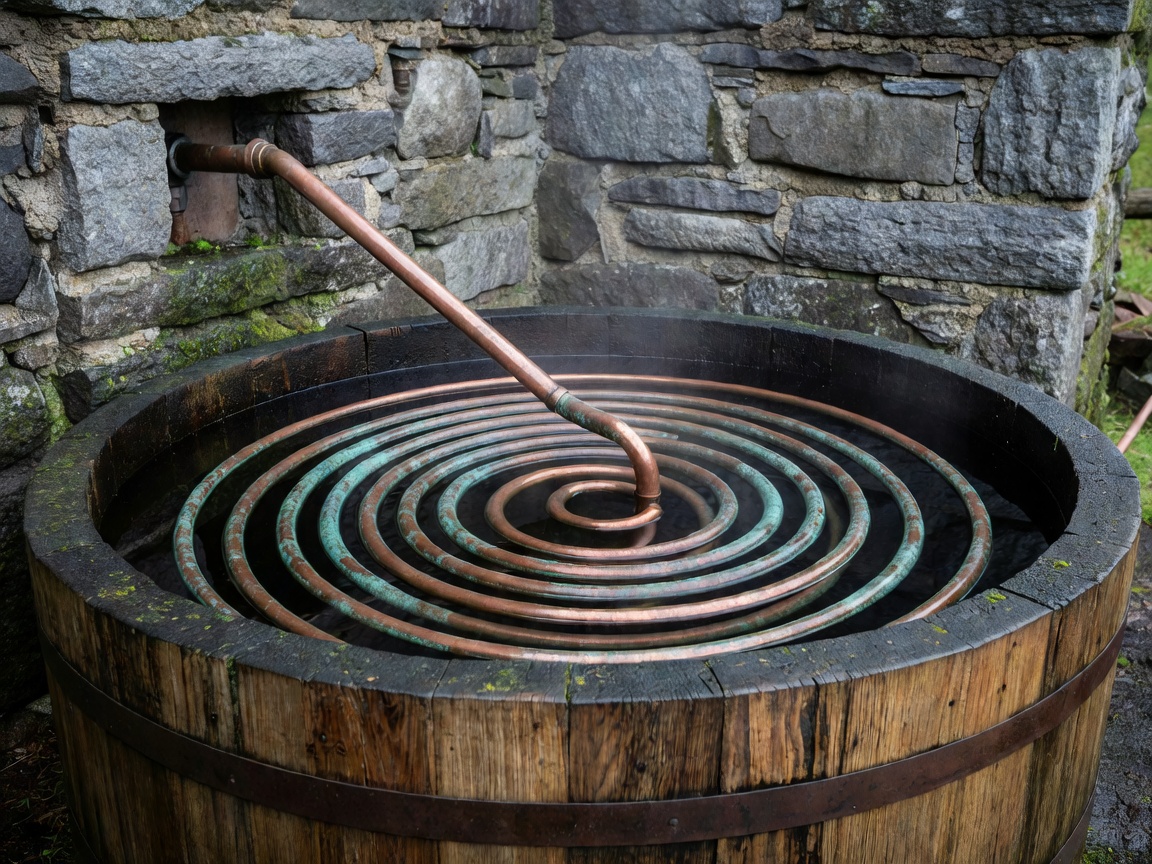
Condenser type. Worm tubs remain in use at Talisker, Oban, Dalwhinnie and Royal Lochnagar among others. Less copper contact means more sulphur compounds survive into the new make, which reads as weight and meatiness young and often integrates into complexity with age.
Cut points. The stillman decides when to start and stop collecting the middle cut. A narrow, early cut gives a cleaner, lighter spirit; running the cut later brings in heavier, oilier compounds. Clynelish's waxy character is the most-discussed example of a house style tied to the handling of feints and the plant that produces them.
Peat, where it is used. Highland Park kilns with heathery Orkney peat cut from Hobbister Moor, which behaves differently from Islay's more maritime peat. Talisker and Ledaig are peated; most mainland Highland distilleries are not.
Maturation across a large region
Warehousing conditions vary more across the Highlands than anywhere else in Scotland, simply because the region spans so much latitude and altitude. Cool, damp coastal warehouses lose more strength relative to volume; warmer, drier conditions lose more volume relative to strength. The industry rule of thumb for Scotland as a whole is that a cask loses in the order of two per cent of its contents a year to evaporation, and that loss compounds — which is the main reason older bottlings cost what they do, rather than any claim about quality.
Cask policy follows the spirit. Lighter northern malts are frequently matured in ex-bourbon American oak, which flatters delicacy. Heavier, worm-tub-derived spirit stands up to sherry-seasoned European oak better. Where a distillery uses both, the difference between its bourbon-matured and sherry-matured expressions is often larger than the difference between two distilleries.
Reading a Highland label
"Highland single malt" narrows the field very little, so read past it. The distillery name is doing the real work, followed by the cask description, the strength and whether there is an age statement. If a label mentions an island, that is marketing geography rather than a legal category — accurate, but not regulated. Where a bottling is peated, it will say so; where it is not, silence is the convention rather than a claim.
A fair test
Judging a region this large
Treat the Highlands as five smaller regions and the map becomes useful again. A northern coastal malt, a Perthshire malt and an Orkney malt have about as much in common as three whiskies picked at random, which is exactly the point: this is the region where you buy the distillery, not the map.
Next: the Lowlands, triple distillation and the grain question